
IT & OT Security, CyberSecurity
Mastering Enterprise Network Infrastructure: Hardware and Core Fundamentals
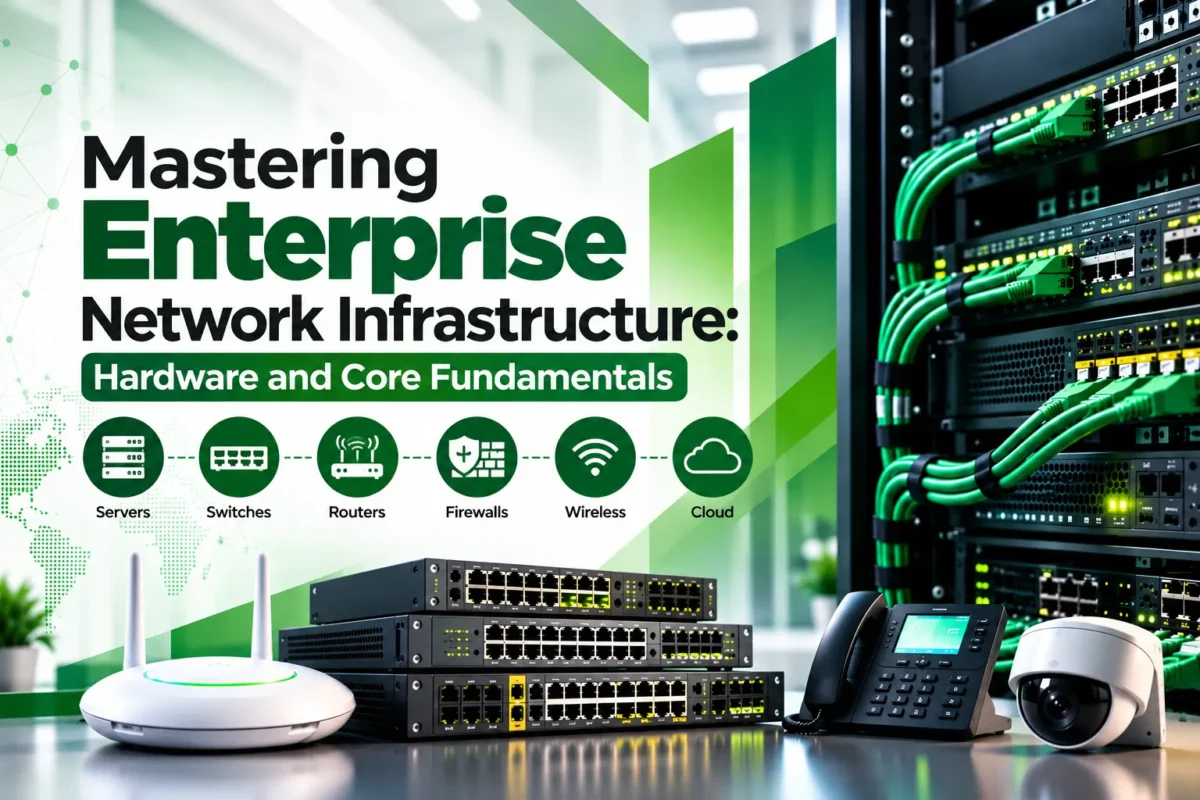
Sep
Enterprise architecture moves fast. Frequently, teams focus on high-level tools like Kubernetes clusters, microservices, and CI/CD pipelines. However, applications often face latency spikes, packet loss, or routing failures. Ultimately, building a resilient enterprise network infrastructure is the core discipline required for absolute success.
You might configure switches, set firewall policies, or deploy virtual private networks (VPCs). Indeed, deep network knowledge separates average setups from high-performance IT environments. To explore professional hardware deployments, check out our specialized IT infrastructure solutions designed for growing businesses.
1. OSI Models in Enterprise Network Infrastructure
Data moves through structured communication models. Before transmission begins, systems must adhere to a standardized framework:
- The OSI 7-Layer Model: A structured framework breaking network communication down from physical media up to the application layer.
- The TCP/IP 5-Layer Model: The streamlined implementation running the modern internet, combining session, presentation, and application tiers.
Furthermore, teams must master encapsulation and decapsulation. In this process, raw payloads transform into frames, packets, segments, and bits. Consequently, this skill remains vital for troubleshooting packet captures and network logs. You can learn more about how we implement these standards by visiting our enterprise hardware solutions page.
2. Core Components of Enterprise Network Infrastructure Hardware
Modern software networks rely entirely on physical infrastructure. Specifically, proper hardware ensures peak performance across data centers:
- Switches & Bridges (Layer 2): Layer 2 switches and bridges use MAC addresses while handling local segment communication. Moreover, they save bandwidth through smart frame forwarding instead of raw broadcasting.
- Routers & Gateways (Layer 3/4): Layer 3 routers and gateways connect distinct subnets and wide-area networks (WANs) by using IP addresses and routing tables. Thus, they drive traffic via optimized hop-by-hop paths.
- Firewalls & Security Appliances: Firewalls and security appliances enforce inspection rules. In addition, they control inbound and outbound traffic to protect sensitive workloads from unauthorized intrusion.
- Enterprise Hardware Solutions: Enterprise hardware solutions matter greatly. For instance, trusted server and networking brands deliver high availability, massive throughput, and long-term reliability.
Alt: High-performance enterprise network infrastructure hardware installed in a server rack.
3. Transport Layer Protocols: TCP vs. UDP
Transport protocols dictate app behavior under load. Therefore, choosing the right mechanism is crucial:
- TCP (Transmission Control Protocol): TCP is connection-oriented because it uses a three-way handshake. Additionally, it guarantees reliable, ordered delivery while including flow control and congestion management like slow-start algorithms. As a result, it is ideal for databases, backend APIs, and financial transactions.
- UDP (User Datagram Protocol): In contrast, UDP is stateless, lightweight, and fast. Because it bypasses connection overhead, it suits DNS queries, live video streaming, and low-latency VoIP calls.
4. Application Layer Services in Enterprise Network Infrastructure
Modern applications rely on robust application-layer protocols:
- DNS (Domain Name System): DNS translates domain names into IP addresses through recursive and iterative queries over UDP port 53.
- TLS (Transport Layer Security): Meanwhile, TLS replaces legacy SSL by providing data encryption, mutual authentication, and cryptographic integrity.
- HTTP/3 (QUIC): Unlike older standards, HTTP/3 moves past older HTTP/1.1 and HTTP/2 bottlenecks. Operating over UDP, it completely eliminates head-of-line blocking.
- Load Balancing & Proxies: Load balancers and proxies manage traffic efficiently. For example, Layer 4 load balancers offer fast, port-level distribution, whereas Layer 7 load balancers provide smart URL-based routing, SSL termination, and caching.
Conclusion
Managing an enterprise network infrastructure is nevertheless never static. Instead, it forms the vital framework for modern enterprise environments. Ultimately, mastering these fundamentals equips your IT team so that you can scale workloads securely, debug distributed systems, and maximize hardware performance. Get in touch with Trade Orient Pakistan for expert consultations on scaling your business hardware today.
